Good morning!
In the Cambridge English dictionary the definition of
Authentic is given as “If something is authentic, it is real, true, or what
people say it is.” Thus if our Christianity is to be authentic, it must be
real, true and what we say it is.
And this is what authenticity really means – for something to
be Authentic it can’t be a copy or a replica – it needs to be the real thing.
The real deal.
 The original.
And our world is so desperately looking for something real.
We are inundated with false advertising, false promises, and false prophets.
From the big scale politicians who promise the earth but deliver dust, to close
friends who lie to us – we all know what it’s like to look for truth, for
authentic love, authentic relationships, authentic leadership – and the world
is looking for the authentic church.
Brennan Manning made the following statement that has often
been quoted “The greatest single cause of atheism in the world today
is Christians who acknowledge Jesus with their lips and
walk out the door and deny Him by their lifestyle. That is what an unbelieving
world simply finds unbelievable."
And apparently Ghandi said, “I
love your Christ, but I dislike your Christianity.” Whether he said it or not the truth remains. People
look at the church today and they judge us on being Authentic.
Are we for real? What does it mean to be authentic?
Last week we looked at the basis for our faith – he looked at what it meant to be
authentically Christian. He presented the gospel to us and challenged us to
follow through with where we were personally – have we handed over our lives to
Christ? Have we admitted to him that we cannot do it alone and we need him –
that we need his forgiveness and his mercy? Have we abdicated the throne in
order to allow Him to be King and Master?
This morning
– we are going to be looking at what it means to be authentically me. Who are
we? Having understood the gospel, how should we view ourselves? How can we be
authentic, true and real versions of who God made us to be?
Our reading
to help us unpack this idea comes from Romans chapter 12 – if you’ll turn there
with me in your Bibles its on page…– Romans chapter 12 and we’re just going to
read the first three verses:
“Therefore, I urge you, brothers, in
view of God’s mercy, to offer your bodies as living sacrifices, holy and
pleasing to God – this is your spiritual act of worship. Do not conform any
longer to the pattern of this world, but be transformed by the renewing of your
mind. Then you will be able to test and approve what God’s will is – his good,
pleasing and perfect will.
For by the grace given me I say to
every one of you: do not think of yourself more highly than you ought, but
rather think of yourself with sober judgement, in accordance with the measure
of faith God has given you.
May God
bless to us the reading of His holy Word, now and forever
Let us pray:
Father may the words of my mouth and the meditations of all our hearts be
pleasing and acceptable to you – Lord speak to us, to our hearts through your
Word this morning. Reveal your truth. In Jesus name we pray – Amen.
The book of
Romans is one of the best systematic layouts of the gospel we have anywhere in
the Bible. Paul slowly and systematically unpacks the basics of the Gospel in
the first eleven chapters, from unpacking the fact that “all have sinned and
fallen short of the glory of God” to “the wages of sin is death but the gift of
God is eternal life through Jesus Christ our Lord” to the Spirit testifying
with our Spirits that we are God’s children.
It finishes
with a doxology, a praise song to God at the end of chapter 11 –
 Oh, the depth of the riches of
the wisdom and knowledge of God!
Oh, the depth of the riches of
the wisdom and knowledge of God!How unsearchable his judgments,
and his paths beyond tracing out!
34 “Who has known the mind of the Lord?
Or who has been his counsellor?”
35 “Who has ever given to God,
that God should repay them?”
36 For from him and through him and for him are all things.
To him be the glory forever! Amen.
And then we
launch into chapter 12 with the word, “Therefore…”
“Therefore I urge you…”
And this is
an important word to begin our journey into what it means to be authentically
me – because we need to start with what we have already established. In many
ways the first 11 chapters are what it means to be authentically Christian –
from here on it looks at what it means to be authentically me because of what
God has done.
This is the
shift from what God has done for us – to what that means and looks like in our
day to day lives. It moves from an explanation of this is what God has done –
to this is what we do in response to his mercy.
And it’s one
of the glorious truths of the Christian faith and one that sets it apart from
all others. In other faiths, and even in the world’s way of seeing things – you
earn… you do in order to get, you perform tasks and achieve things to gain
approval, love acceptance or mercy.
Here we are
given grace and mercy and acceptance and love – and therefore… we respond.
Our first
place of understanding who we are and what it means to be authentically me, is
to understand who God is and what God has done for us. It is understanding that
God loves us so much that he gave his only Son that we might have life. Not
because of anything we have done, or will do. Not because of who we are or
where we live or what we look like. Not because we are worse or better than
anyone else.
But because
God loves us. Because he chose us. Because he cherishes us. Because he delights
in us.
Being
authentically me means knowing that I am loved, accepted, cherished and that I
belong to him. I don’t need to try be something I’m not, I don’t need to try
earn his favour, I don’t need His approval – I have it.
It is a
place of security. A firm, solid rock to base all that we feel and think about
ourselves on. A port from where we go out and live as the loved children of
God.
If you
remember the definition of authentic from earlier, it’s that which is real,
true and it matches what people say and people do. The Scriptures tell us what
is real and true about us – but part of the struggle of being authentic is that
we often tend to journey between two extremes when it comes to what we think
and believe about ourselves.
There is the
inflated self – the person who believes that they are the Master of their fate,
the self-made-man, the one in charge and in control and who has it all together
all of the time. ‘I did it my way’ is the song on their lips. And people like
this are often praised for their confidence and surety. Trust no one but
yourself. You get nothing for nothing in this world. But it is not true, and it
is not real. Our very next breath is a gift from our Maker. We cannot control
our own heartbeats let alone the course of our lives. And the truth that the
gospel tells us here is that we cannot save ourselves – the reality is that God
reached down in mercy and pulled us up. That is what is true and real.
The second
trap is that we live with a deflated sense of self. This is the feeling of
unworthiness, of being unloved, not good enough, and unimportant. Interestingly,
this low self-esteem can often lead to behaviours and character traits that
seem contrary to it. Brene Brown, a researcher in the areas of vulnerability
and authenticity talks about narcissism saying:
“When I look
at narcissism through the vulnerability lens, I see the shame-based fear of
being ordinary. I see the fear of never feeling extraordinary enough to be
noticed, to be lovable, to belong, or to cultivate a sense of purpose.”
The deflated
sense of self says – I’m not loveable or I’ve done such and such that God could
never forgive me. What we don’t like to see is what this really is saying is
that God isn’t enough. That the cross wasn’t enough. That my sin, badness,
ordinariness, unlovely-ness is greater than God’s forgiveness, grace, delight
and love.
And the
problem is that both extremes result in us gazing at ourselves,
whether with
delight or disgust and not gazing at God.
How do we do
this? How do we learn to be authentic? How do we fix our warped perceptions and
skewed ideas of who we are – and become truly real, become who God says we are?
Our passage
gives us three tasks.
Firstly it
tells us to offer our bodies as living sacrifices, holy and pleasing to God as
our spiritual act of worship. Authentic worship is what we’ll be looking at in
detail next week.
The message
Bible has a lovely way of saying verse one of Romans 12:
 So here’s what I want you to do, God
helping you: Take your everyday, ordinary life—your sleeping, eating,
going-to-work, and walking-around life—and place it before God as an offering.
Embracing what God does for you is the best thing you can do for him.
So here’s what I want you to do, God
helping you: Take your everyday, ordinary life—your sleeping, eating,
going-to-work, and walking-around life—and place it before God as an offering.
Embracing what God does for you is the best thing you can do for him.
Worship is
about living a life that is focused on God in every way. Offering everything we
do to him – keeping our eyes on Him not just as we stand here and sing songs –
but Monday through Saturday. That we do everything knowing that it is an
offering to Him. Our work is an offering. Our rest is an offering. Our very
lives are His.
Paul in his
letter to the Corinthians talks about whatever you do – do it for the glory of
God. And this simply helps gets our focus right. We realise it’s not about us
but about how we are honouring him. But at the same time we have purpose and
meaning – we live lives of peace, justice, mercy, graciousness and love because
we live to honour him.
The second
task we have is to not be conformed to the pattern of this world, but to be
transformed.
E.E Cummings
wrote, "To be nobody-but-yourself in a world which is doing its best,
night and day, to make you everybody but yourself - means to fight the hardest
battle which any human being can fight- and never stop fighting.”
The
standards the world sets for us result in us comparing ourselves to others and
judging both others and ourselves. This results in us feeling better than
“those people” and having an inflated self, or feeling that we’ll never be as
good as “those people” and having a deflated self.
The world’s
standards are false. We are constantly being told – This is beautiful. This is
perfection. This is success. This is happiness. This is love. If you have this
job, this house, this car, this brand of cool drink or pair of jeans you meet
the standard.
We see this
judgment come through in parenting styles, in how you should dress, in what you
should do with your money and where you should live.
And it goes
even deeper than that. We see it in what are acceptable character traits. Being
business smart is placed higher than having integrity. Being right over being
kind. Doing things quickly and cheaply rather than doing them well.
We live our
lives constantly being told by the world what we should do and who we should
be.
God’s word
tells us who we are – and because of that what we should do. Our task is to
change our measuring stick. Throw out the comparisons you make of yourself to
others. Ask God who it is that you are and who he is making you to be.
Verse 2 in
the Message Bible reads:
Don’t become so well-adjusted to your culture
that you fit into it without even thinking. Instead, fix your attention on God.
You’ll be changed from the inside out. Readily recognize what he wants from
you, and quickly respond to it. Unlike the culture around you, always dragging
you down to its level of immaturity, God brings the best out of you, develops
well-formed maturity in you.
Our final
task comes in verse three
For by the grace given me I say to
every one of you: do not think of yourself more highly than you ought, but
rather think of yourself with sober judgement, in accordance with the measure
of faith God has given you.
Our first
task is to worship, our second is to not compare ourselves to the world, and
the last one here is to be real and honest about who you are, both in how you
think and in what you present to the world.
Think of
yourself with sober judgement… sound judgement… with modesty. Realise your
incredible worth – the fact that someone loves you enough that he was prepared
to die for you. Realise that while loved and chosen, we are just dust. Psalm
103 says it so beautifully – and compares it so clearly saying:
“As a father has compassion on
his children,
so the Lord has compassion on those who fear him;
for he knows how we are formed,
he remembers that we are dust.
The life of mortals is like grass,
they flourish like a flower of the field;
the wind blows over it and it is gone,
and its place remembers it no more.
But from everlasting to everlasting
is the Lord’s love.”
so the Lord has compassion on those who fear him;
for he knows how we are formed,
he remembers that we are dust.
The life of mortals is like grass,
they flourish like a flower of the field;
the wind blows over it and it is gone,
and its place remembers it no more.
But from everlasting to everlasting
is the Lord’s love.”
In our
interaction with the world, we need to remember who we are. And we need to be
secure enough in it to not present any other self, other than one is broken,
sinful, and limited, and yet loved, secure and accepted. We need to show the
world that we are simply servants and worshippers of a great God, and that any
glory actually belongs to Him. We need to present to the world a real person,
not someone who is perfect, or who has it all figured out, or who knows it all
and therefore can judge. But what if rather we went out as fellow travellers on
a journey, seeking God, being transformed and learning to worship Him with our
lives.
Being Authentically me means knowing who I am before God. It
means understanding who he has created me to be, and rejoicing in the fact that
all his work is good and beautiful and his plans can be trusted. It means not
falling into traps of thinking we are better or worse than we are – but rather
realising that in order to see ourselves clearest we need to look at the mirror
God holds up rather than the world’s mirror. And then we need to live out this
truth into the world.
I pray that as you go into your week, that this will be
something you ponder over, pray about and ask for God’s help in understanding
what it means to be authentic.
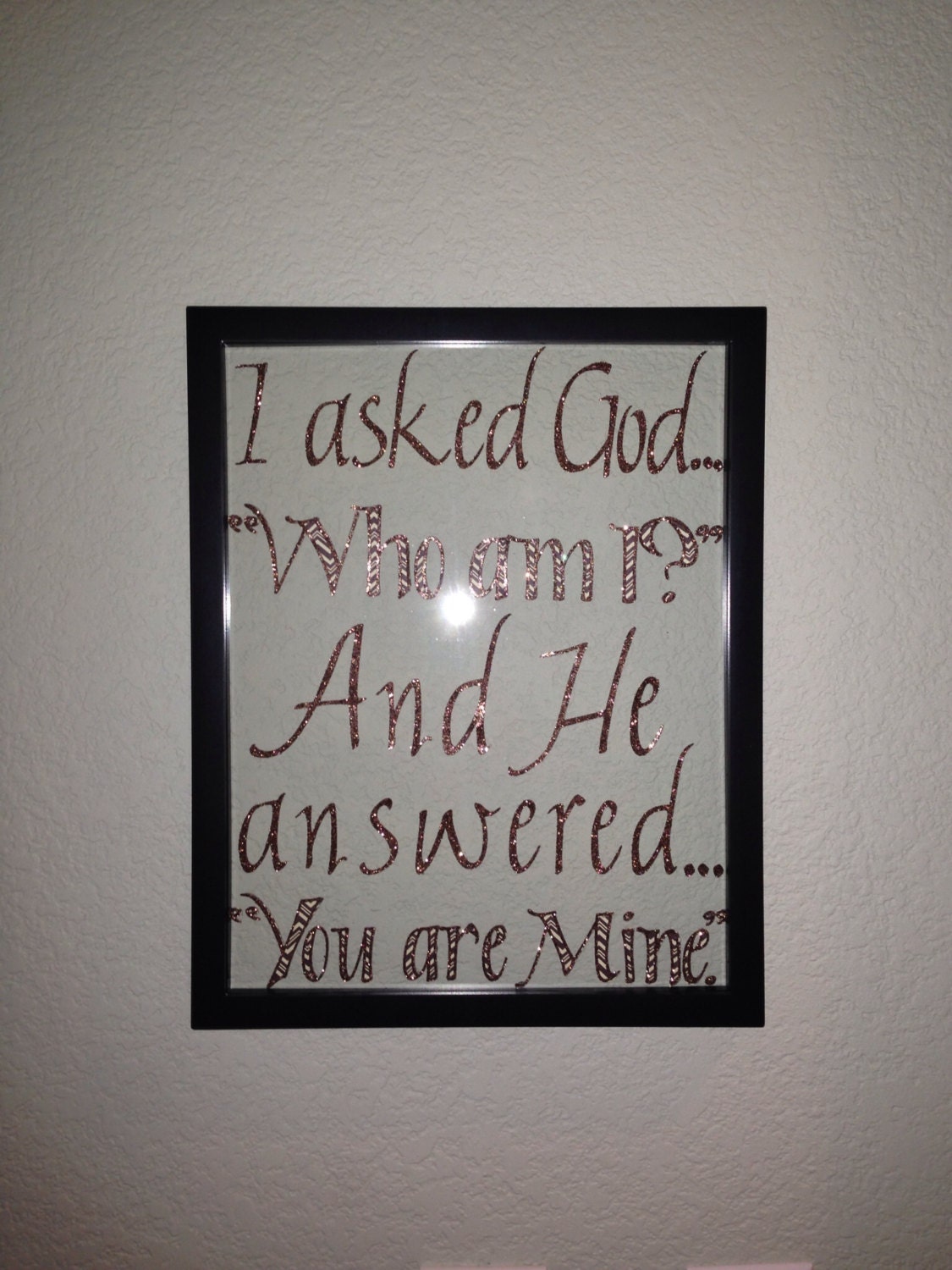
God who am I to you?
God who do you want me to be?
God help me to see the truth.
God help me not to be caught up by the world.
God give me the faith and courage to live as you have called
me to live everyday.
Amen.