We’re continuing in our sermon series
which is an unpacking of the Acts 11 passage by looking into the different key
phrases we find in the passage.
This morning I want to pick up on the
phrase “Believe and Turn”. It’s a phrase found right near the beginning of the
Acts 11 passage – so we’ll start by reading just the first few verses there to
see it in context.
“Now those who had been scattered by
the persecution in connection with Stephen travelled as far as Phoenicia,
Cyprus and Antioch, telling the message only to Jews. Some of them, however,
men from Cyprus and Cyrene went to Antioch and began to speak to Greeks also,
telling them the good news about the Lord Jesus.
The Lord’s hand was with them, and a
great number of people believed and turned to the Lord.”
May God bless to us the reading of his Holy Word, now and
forever.
Let us pray. Father may the words of my mouth and the
meditations of all our hearts be acceptable and bring you honour and glory.
Thank you for your word to us this morning. In Jesus name Amen.
“The Lord’s hand was with them, and a
great number of people believed and turned to the Lord.”
Believe and turn.
 When I first saw this phrase my
initial reaction was “I’ll probably pick that one last!” I’m not entirely sure why – I think it has something to
with how I associated it with the ‘turn or burn’ sermon style… a frightening
sermon where the minister would threaten the congregation with judgement and
hell if they didn’t turn and believe.
When I first saw this phrase my
initial reaction was “I’ll probably pick that one last!” I’m not entirely sure why – I think it has something to
with how I associated it with the ‘turn or burn’ sermon style… a frightening
sermon where the minister would threaten the congregation with judgement and
hell if they didn’t turn and believe.
But then I read the passage again,
and again, and suddenly this phrase actually became appealing. I began to see
it in a different light altogether. One of the Bible stories that I believe can
help us understand this phrase well comes from the Old Testament – Numbers 21
The background to this text is that
it takes place during the 40 years of wandering in the desert. The Israelites
received the Law at Mount Sinai, travelled to the borders of Canaan where the
twelve spies went in and brought back reports – ten of them saying – we cannot
do this, its impossible, and only Joshua and Caleb saying, Yes there are
giants, but the Lord is on our side – we can do this!
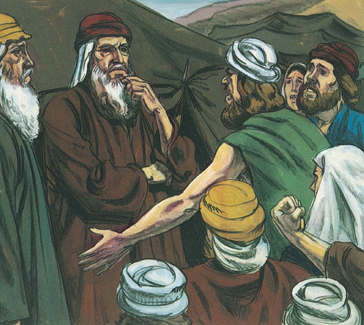 The people trust the 10 spies over
the two and God declares that because of their lack of trust in him, they would
wander for 40 years before being able to enter into the land again. God has
been providing food in the form of Manna – bread from heaven, and by sending
flocks of quail for meat. He’s provided water in miraculous ways, like pouring
out of a rock. And yet time and again the people lose faith, complain and begin
to look back to Egypt. In the beginning of chapter 21, God has just given them
victory over a King who attacked them. And so we begin our reading in verse 4:
The people trust the 10 spies over
the two and God declares that because of their lack of trust in him, they would
wander for 40 years before being able to enter into the land again. God has
been providing food in the form of Manna – bread from heaven, and by sending
flocks of quail for meat. He’s provided water in miraculous ways, like pouring
out of a rock. And yet time and again the people lose faith, complain and begin
to look back to Egypt. In the beginning of chapter 21, God has just given them
victory over a King who attacked them. And so we begin our reading in verse 4:
“They travelled from Mount Hor along the route
to the Red Sea, to go around Edom. But the people grew impatient on the way;
they spoke against God and against Moses, and said, “Why have you brought us up
out of Egypt to die in the desert? There is no bread! There is no water! And we
detest this miserable food!”
Then the Lord sent venomous snakes among them;
they bit the people and many Israelites died. The people came to Moses and
said, “We sinned when we spoke against the Lord and against you. Pray that the
Lord will take the snakes away from us. So Moses prayed for the people.
The Lord said to Moses, “Make a snake and put
it up on a pole; anyone who is bitten can look at it and live.” So Moses made a
bronze snake and put it up on a pole. Then wen anyone was bitten by a snake and
looked at the bronze snake, he lived.”
Believe and turn.
There are a couple of interesting
things to pick up in the passage. Firstly, this is the harshest complaint
against the Lord given – “We detest this miserable food.” No bread, no water.
And yet time and time again God has provided for them. They have again
forgotten that the provision they receive daily is pure grace. They don’t have
to harvest wheat and bake bread – they’re in a desert. There is nothing… and
yet God provides his Bread to nourish and sustain them. Purely by grace. And
they at first battle t trust that it will arrive every day – yet God is proved
faithful there. Now they are so used to it arriving that they now despise it. How
shallow, how arrogant… and yet how human. Are we not like this? We simply
expect our provisions because we believe that we’ve worked or studied or gotten
the job we have by our own sweat, and therefore nothing dare threaten it.
Because we deserve it. It’s a powerful reminder that all we have, our sweat and
blood, our very next breath, our ability to work, the job we have – are gifts,
they’re a grace.
The other interesting thing to notice
is that God doesn’t do what they ask… Pray
that the Lord will take the snakes away from us. So Moses prayed for the
people. God doesn’t take the snakes away. Rather he provides a way to
escape the death that follows. And the provision comes through believing Him to
provide healing and then turning from wherever they are, and whatever they are
doing and gazing upon the snake of bronze, lifted up high to be seen by all. Fast-forward
about 1500 years… Jesus applied this well-known event to his own lifting up on
the cross. In the conversation he has with Nicodemus, the Pharisee in John 3,
He said, “As Moses lifted up the snake on a pole in the desert, so the Son of
Man must be lifted up. Then,” said Jesus, “Everyone who believes in him will
have eternal life. For God so loved
the world that he gave his one and only Son, that whoever believes in him shall
not perish but have eternal life. For God did not send his Son into the world
to condemn the world, but to save the world through him.”
The symbol of the snake on the pole, while Moses and the
Israelites at the time had no idea, was one of the many pointers to Christ, the
promised Messiah, and it was a picture of what He would do not only for the
Israelites, but for all mankind.
 Many times in Scripture, snakes or serpents are indicative of
sin. We see the snake In the Garden of Eden – and because of that people may
question, how Jesus can equate Himself hanging on the cross with the snake
hanging on the pole – and yet while Jesus hung on the cross, he was covered and
carrying the sin of the world, the brokenness of humanity from the moment time
began until it will end one day – all the filth and evil and despair that goes
with it was poured onto him. His physical suffering there, while terrible, was
only part of the terrible agony. And so covered by sins, your and mine, he is
separated from God. And so a snake is a fitting symbol, because all of our sin
hung on that cross with Jesus.
Many times in Scripture, snakes or serpents are indicative of
sin. We see the snake In the Garden of Eden – and because of that people may
question, how Jesus can equate Himself hanging on the cross with the snake
hanging on the pole – and yet while Jesus hung on the cross, he was covered and
carrying the sin of the world, the brokenness of humanity from the moment time
began until it will end one day – all the filth and evil and despair that goes
with it was poured onto him. His physical suffering there, while terrible, was
only part of the terrible agony. And so covered by sins, your and mine, he is
separated from God. And so a snake is a fitting symbol, because all of our sin
hung on that cross with Jesus.
Believe and turn.
Just as the snakes were not taken away, so sin has not been
removed from our world yet. We still see the effects of it all around us, and
we still see its effects inside us. We don’t have to look far to see brokenness
and injustice in our world. We have all been touched by grief, by illness, by
the insensitivity of another. And while we are being changed inside, we still
struggle and fight sin within. Paul writes in Romans 7,
“I do not understand what I do. For
what I want to do I do not do, but what I hate I do. As it is, it is no longer
I myself who do it, but it is sin living in me. For I know that good itself
does not dwell in me, that is, in my sinful nature. For I have the desire to do
what is good, but I cannot carry it out.
For I do not do the good I want to do, but the evil I do not want to
do—this I keep on doing.
So I find this law at work: Although
I want to do good, evil is right there with me. What a wretched man I am! Who
will rescue me from this body that is subject to death?”
And then beautifully, in the last verse of the chapter – he
answers his own question:
“Thanks be to God, who delivers me
through Jesus Christ our Lord!”
This is belief. I believe that sin does not have the final
say. I believe that brokenness does not rule my life. I believe that evil will
not win in the world. I believe that I cannot fix this myself. I believe that
Jesus has done it for me, and for you, and for the world.
When the men from Cyprus and Cyrene brought the good news to
the Greeks in Antioch – this was the good news they brought. Your sins do not
need to rule over you, they will no longer bring death. Just as the Israelites
could believe in God healing them when looking upon the serpent, we can believe
in God saving us too – by looking upon the cross.
And this is what we sing of – In How great Thou Art we sing
the words:
And when I think
that God his son not sparing,
Sent him to die
- I scarce can take it in,
That on the
cross my burden gladly bearing,
He bled and died
to take away my sin:
The hymn it is
well with my soul has this verse:
My sin, not in
part but the whole,
Is nailed to the
cross, and I bear it no more,
Praise the Lord,
praise the Lord, O my soul!
This is what we believe.
And because this is what we believe – we turn. Acts 11 says,
“The Lord’s hand was with them, and a
great number of people believed and turned to the Lord.”
Just
as those bitten in the desert, acted in belief and literally would turn from
where they were towards the bronze snake to look up at it – so because of their
belief in Antioch, because of what we believe, we turn to the Lord.
In
Christian lingo we use the word repentance. But it’s important to remember that
it is not repentance that saves us, but rather the sign that I believe what I
believe. It goes together. The belief in God’s healing resulted in a turning to
the snake on the pole, the belief in God’s salvation for us, results in us
turning to the cross. Oswald Chambers explains it like this:
“There
is a danger to put the emphasis on the effect instead of on the cause. Is it my
obedience that puts me right with God? Never! I am put right with God because
prior to all else, Christ died. When I turn to God and by belief accept what
God reveals, instantly the stupendous atonement of Jesus Christ rushes me into
a right relationship with God. By the miracle of God's grace I stand justified,
not because of anything I have done, but because of what Jesus has done. The
salvation of God does not stand on human logic; it stands on the sacrificial
death of Jesus. Sinful men and women can be changed into new creatures by the marvellous
work of God in Christ Jesus, which is prior to all experience.”
And
so the turning is as a result of what we believe, is as a result of what Christ
has already done for us.
And
so there are two responses from this for us today. If believing and turning is
something you have never done, if you have never come to the point where you
have recognised that because of your sin and brokenness, you cannot save
yourself – then there is the call to salvation, where I can say, Listen – this
is what Jesus has done for you and it is a beautiful thing – freely available
to everyone, everywhere – it is a gift– believe and turn! Believe that he has
done it, turn to Him, and receive his salvation. Turn to Him, talk to Him this
morning, admit this to Him, thank Him for the cross and ask Him to live in you
and change you, to be your Lord from today onwards.
But
many of you here have done that – many of you have been walking with Jesus,
loving and serving him as Lord for many many years.
To
you I would encourage two things.
Remember
what you believe. Be reminded of the horror and the beauty of the cross.
Remember that this free gift cost God his very heart – the life of his only
Son. Remember that it was done because he loves you. Remember that you didn’t
do this – That He did it all.
And
then turn… Because turning is not a once
off thing. We turn each Sunday when we come here and pray our prayer of
confession, we turn away from the things that have kept us from God and begin
again, in fact every time we come to God and confess our sins we are turning to
Him.
But
I believe that it goes even further than that. Every day we are faced with
choices. Every single choice we make turns us towards God or away from Him. CS
Lewis talks about this in his book Mere Christianity, where he argues that each
choice we make either journeys us towards becoming a more heavenly being, or
more hellish. Every moral choice we make is either saying yes to God and to His
ways, or No. Either moving us towards Him, or further away. The choice of
getting up this morning and coming to church, a time where you could focus on
Him and worship… The choice of reaching out in kindness to someone even if it
costs us precious time. The choice of telling the truth even when we feel it
will count against us. The choice of speaking hopelessness and negativity, or
speaking life. Each of these choices is a turning.
Believe
and turn.
I
pray that this morning the reality of your salvation will be real to you once
again… that you will realise as the Israelites did with the snakes, that Jesus
is our only hope – and because of that has become our everything. I pray that
you remember what it is that you believe and be amazed once again by its
beauty. I pray too that you will always choose when confronted by the snake of
sin, to turn to the cross, to choose Jesus and His way.
Let
us pray.


