Tuesday, 14 April 2015

The Last Week of Jesus Series: The True Teacher Sermon (Mark 12 & 13)

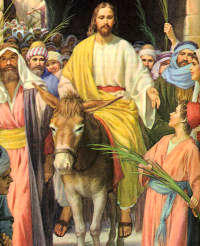
So by now you’ll have travelled with us for several Sundays as we have walked the last week with Jesus. We’re working our way through the last six chapters of the book of Mark which gives us a beautiful picture of where Jesus was and what he was doing for the last week of his life before the cross. And so we started on Sunday two weeks ago, as Jesus entered Jerusalem for the first time, on the back of a donkey –to shouts of Hosanna, and Blessed is he who comes in the name of the Lord. With palm branches like the ones we see here.

Then Monday – the mood is quite different as we see his power and authority in the way in which he cleared the Temple – threw out the money changers and created pandemonium… officially starting a process whereby the leaders are looking for an opportunity to kill him.

Last week we moved onto Tuesday – the day where we spend a great deal of his time teaching the people and being challenged by the religious leaders as they look for ways to trap him. We looked at the authority with which he responded to the traps set for him by different religious leaders. I sometimes feel sorry for these men as they had no idea that they were up against God himself.

Today we continue in that vein looking at some of the teaching Jesus spoke on the Tuesday. We need to remember that in just three nights’ time Jesus is going to be arrested and taken away. Nothing that he teaches on here is going to be trivial.

Our next section runs from verse 18 all the way through to the end of chapter 13 as you will see in your hand-outs. I’m only going to pick up on three sections of this reading which I believe look at what Jesus wanted us to know about being a Christ follower – and our first one starts in chapter 12:28

One of the teachers of the law came and heard them debating. Noticing that Jesus had given them a good answer, he asked him, “Of all the commandments, which is the most important?”
“The most important one,” answered Jesus, “is this: ‘Hear, O Israel: The Lord our God, the Lord is one. Love the Lord your God with all our heart and with all your soul and with all your mind and with all your strength.’ The second is this: ‘Love your neighbour as yourself.’ There is no commandment greater than these.”
“Well said, teacher,” the man replied. “You are right in saying the God is one and there is no other but him. To love him with all your heart and with all your understanding and with all your strength and to love your neighbour as yourself is more important than all burnt offerings and sacrifices.”
When Jesus saw that he had answered wisely he said to him, “You are not far from the kingdom of God.” And from then on no one dared ask him any more questions.”

Last week we looked at a number of questions that were thrown at Jesus by the authorities – with the specific goal of catching him out – of getting him to say something that would either incriminate himself, or turn the crowds against him. The question about paying taxes is a perfect example of this – if Jesus said they shouldn’t pay taxes – then they would have something to take to the Romans to get him arrested. If he said they should, the crowd would reject him as the Romans were oppressive.

But this question, which is the last asked, comes from a completely different place – it’s as if Mark wanted us to know that not all the religious leaders were bad, but rather that there were some who still sought truth and were open to this man from Galilee. And he is not alone. At the end of Mark we hear about Joseph of Arimathea who we are told was a ‘prominent member of the Council, who was himself waiting for the kingdom of God’ goes and boldly asks Pilate for Jesus body so that it might buried according the their customs. We are also told in John about Nicodemus – both asking Jesus honest questions and being there at his death.

And so this man, hearing the questions hurled at Jesus and listening to his wise answers – asks a real one.
What is the most important commandment?
Image result for The greatest commandmentIn all our rules and regulations – what is it that makes us followers of our God. What is it that holds it all together?

The answer that Jesus gives comes from two places in the Old Testament, the first commandment comes from Dueteronomy 6:4-5. This is known as the Shema –which means hear or listen… - and is still recited by Jews today as an integral part of their identity. In fact it is said that when a baby is born it is whispered into their ear, and again when someone is on their deathbed this is once again recited. It is their central text…

Hear O Israel: The Lord our God, The Lord is one. Love the Lord your God with all your heart and with all your soul and with all your strength.”
 and the second comes from Leviticus 19:18
You shall love your neighbour as yourself”

Interestingly in the other gospels, in answer to the question, ‘who then is my neighbour’, Jesus follows this up with the parable of the good Samaritan – challenging them to recognise that their neighbour may not necessarily even be from their own community group. It’s again a reminder that while the Jews had become so insular and self-focused, the good news was for everyone.

In these two laws Jesus teaches about a selfless love. Love for the God that has created us, and love for those around us, whether they form part of our circle or not. And just as the question was asked – what makes us truly Jewish? – so it rings true for us today – what makes us true followers of Christ? And the first answer would be selfless love. A love that looks upward and outward. 

Our second reading is going to come from Mark 12:41 - 44
“Jesus sat down opposite the place where the offerings were put and watched the crowd putting their money into the temple treasury. Many rich people threw in large amounts. But a poor widow came and put in two very small copper coins, worth only a few cents.
Calling his disciples to him, Jesus said, “Truly I tell you, this poor widow has put more into the treasury than all the others. They all gave out of their wealth; but she, out of her poverty, put in everything – all she had to live on.”

As ministers, we are always so hesitant to talk on the issue of money. Unfortunately since some churches abuse this area of teaching most of us will run a mile before writing a sermon on the topic of tithing. This next section of Jesus teaching deals with giving, but I believe is dealing with far more than just money. And I say just money because sometimes money is actually the easier thing to give.

Image result for Jesus TeachingJesus has been standing in the Temple Courts debating with the religious leaders and teachers, and actually has just finished warning the people against them. He now sits down – and as he does he has a full view of the offering bag. And after watching a while he calls his disciples to him and points out a widow in ragged clothes as she makes her way home. She only dropped two small coins in the bag – mere change. Worthless really. But Jesus draws attention to her and commends her for giving more than all the others.

And this is because she gave selflessly. She gave more than she was able.
Just as selfless love is a mark of being a follower of our Jesus. So is selfless giving. Giving of ourselves to God and to others.
And yes this can be financial. But it’s also giving of our time, giving of our skill, giving of our empathy, giving of our wisdom.

And to give selflessly means to be willing to give beyond what we are able. Bill Hybels has a measure on how one should tithe – and he says pick a number, once you have a number start to raise it higher until you say “ouch” – and that’s how much you should be giving away.

If that’s the measure… what does it look like in terms of time? How do we give more than we have and yet still function effectively? How does it work in terms of emotional energy? How do we give more and not run on empty?
I believe we do this by listening well and refuelling – and both happen at the feet of Jesus. If we want to live lives that are selfless, that are giving – we need to be spending time with Jesus so that he can guide us in terms of our priorities and our time – so that we spend it wisely and are able to give more away. And by spending time with him we save ourselves from developing a Martha mentality of Lord don’t you care that I’m slaving away here? Emotionally when we set aside time to sit at Jesus feet we will have more to give away because he is the one refilling and refuelling.

Remember that the Christian life is a life where the impossible because possible because we live it hand in hand with the God of the Universe. He is the one who allows us to give – because we have received everything from him first.

Selfless love and selfless giving.

Our final reading comes from Mark 13. Now the whole of chapter 13 speaks about the end times – it contains difficult to understand passages about signs and terrors that will point towards the end of the world – and finishes on the passage which speaks about no one knowing the time or hour, but that we should be ready. I’m going to just pick out verses 5 - 13
“Jesus said to them, “Watch out that no one deceives you. Many will come in my name, claiming, ‘I am he,’ and will deceive many. When you hear of wars and rumours of wars, do not be alarmed. Such things must happen, but the end is still to come. Nation will rise against nation, and kingdom against kingdom. There will be earthquakes in various places, and famines. These are the beginning of birth pains.
You must be on your guard. You will be handed over to the local councils and flogged in the synagogues. On account of me you will stand before governors and kings as witnesses to them. And the gospel must first be preached to all nations.
Whenever you are arrested and brought to trial, do not worry beforehand about what to say. Just say whatever is given you at the time, for it is not you speaking but the Holy Spirit.
Brother will betray brother to death, and a father his child. Children will rebel against their parents and have them put to death. Everyone will hate you because of me, but the one who stands firm to the end will be saved.”

Until recently, speaking of martyrdom and persecution of Christians was something we spoke about either as happening long ago or far away. We would often use the disciples as examples citing how each of them except John who was exiled, was put to death for following Jesus. We also would speak about areas in the world where it was still happening but always very hushed – and often denied.

Recently a video went viral of Isis beheading 21 Egyptian Coptic Christians on a beach this year. The title of the video is A Message signed with blood to the nations of the cross. And suddenly this whole thing becomes a whole lot more real to us all. These young men were specifically targeted for the Christian faith.
And now we believe and pray that that is something we will never have to face. But it certainly has had me re-examining my faith and what it means to me.

Because Jesus calls us to a selfless life. A life where it’s no longer about us, but rather all about him. A life where our love and our gifts are poured out in service to God and to others.

Fred Craddock, in an address to ministers, caught the practical implications of what this would mean. "To give my life for Christ appears glorious," he said. "To pour myself out for others. . . to pay the ultimate price of martyrdom -- I'll do it. I'm ready, Lord, to go out in a blaze of glory. "We think giving our all to the Lord is like taking Rl,000 cheque and laying it on the table-- 'Here's my life, Lord. I'm giving it all.'
Image result for Small changeBut the reality for most of us is that he sends us to the bank and has us cash in the Rl,000 for 5 cent coins. We go through life putting out 25 cents here and 50 cents there. Really listening to the troubles of a child instead of nodding uninterestedly. Going to a committee meeting. Giving a cup of water to a shaky old man in a nursing home. Making that phone call. Reconciling with someone who hurt you. Showing grace where it isn’t deserved. Usually giving our life to Christ isn't glorious. It's done in all those little acts of love, 25 cents at a time. Martyrdom can mean living the Christian life little by little over the long haul."
The one who stands firm to the end will be saved.

And so the ultimate teacher spends his Tuesday teaching us how selfless love, selfless giving and selfless living are all bound up together and are the call we have on our lives to follow Him. It is not an easy call. It is not a call that is comfortable and nice. It is a high call. It is a call to selflessness.
But it is because we follow the teacher who was the ultimate example in selflessness. Our verse for this lent period reads, “For even the Son of Man did not come to be served, but to serve – and to give his life as a ransom for many.”

We too are not here to be served… but to serve. To love. To give. To lay down our lives.

And the temptation here is for me to qualify all this by encouraging you to 
say – this is the best way to live. This is the way of adventure and fulfilment. This is the way of seeing God work with you and in you and through you so that you will see Him reach a world that needs him. I could encourage you by talking about the life in abundance, and life of purpose.
And it would all be true.
Many of you have lived this way and experienced these truths first- hand and could testify to the immense joy found in this high calling.

But then it would be all about you again.
And it’s not.
It’s all about Him.

The Lord our God, the Lord is one. Love the Lord your God with all our heart and with all your soul and with all your mind and with all your strength.’

Monday, 13 April 2015

The Last Week of Jesus series: The True Temple Sermon (Mark 11:12-19)

Monday arrived bright and fair and Jesus with his 12 disciples headed back to Jerusalem. Each of them were lost in their own thoughts remembering the day before and curious at what today would hold. Yesterday was glorious. Their Master Jesus – having secured a donkey had ridden quietly into Jerusalem… well at Jesus was quiet – the crowds were not. As the numbers in the city had begun to swell in preparation for the Passover, so had the crowdedness as they had made their way to the city gates – and suddenly a group had appeared, palm branches held high, cloaks thrown on the floor, and a passageway fit for a King stood before them. Joyful cries of Hosanna to the Son of David, Blessed is he who comes in the name of the Lord! had rung out… finally the world was seeing who Jesus truly was. The celebration had lasted almost the whole day as they slowly made their way towards to Temple. Simon was wondering if this was the start of a rebellion they were to lead, surely there were now enough people behind them to overturn the Roman filth.

Thomas was wondering if the same would happen today – would they be greeted the same?
Peter was nervous. His Master kept speaking of dying… was he really going to be arrested and killed? Surely not.

Each was remembering and chatting, ahead of them Jesus simply lets them know that he is hungry. “That shouldn’t be a problem” thought Andrew remembering the loaves and fishes incident of a few weeks back!
But spotting a fig tree en-route up ahead, they scrambled towards it. It was a magnificent tree – promising so so much. And yet as Jesus searched through the branches - he found nothing edible. No fruit, just leaves. He stepped back and addressed the tree with a solemnity that caught the disciples by surprise, “May no one ever eat fruit from you again.” he said. And without a backward glance – continued his journey into the city.

When they arrived this time, the crowds spotted Jesus and began to follow the twelve… The excitement was tangible. There were some who had held their branches the day before, some who had just arrived but news about this Jesus had spread far and wide and who were thrilled to finally catch a glimpse of the man, some who still eyed him with scepticism and distrust. “What will he do today? Will he teach us some more? Will we see a miracle? I heard that there was a blind man healed just two days ago. I heard that he fed everyone who followed him. I heard him teach – you have never heard the kinds of things that this man says…” And so the conversations swirl around them as they made their way to the Temple.

As they enter through the first gate of the Temple, they notice a hive of activity. It’s the busiest time of year for Temple business and people have come from far far afield to worship and honour their God, to bring their sacrifices to him, and to worship. Through this first gate they are standing in the court of the Gentiles – the one place where those not of Jewish standing but who know and love the Lord are permitted to meet with Him… not that they had much opportunity – A market-place hub of activity had taken over what was to be a church. There were people selling lambs and doves and goats for sacrifices… convenient for sure – as it meant you could bring money with you on your journey – and simply purchase the animal at the Temple rather than lugging it along on a journey of many miles and many days. It also meant that those from other countries could exchange their money for the correct currency right there in the courtyard. .. and then purchase their sacrifice.

Sure the market here wasn’t particularly honest but it was a convenience – it was only really the poor that struggled with that… and sure, it got in the way of those Gentile guys worshipping – but they were only Gentiles…

As they entered through these gates – Jesus froze. His eyes welled up with unshed tears and his hands balled into fists. Suddenly in a flash of rage that simply burst from within him – he rushed at the first money changing table, caught it from underneath and flipped it up, the sound of coins exploding into the air echoed off the Temple walls – he then spun around and caught the next table doing the same – sending coins rolling in all directions – everyone too shocked to even think of chasing after them. Without even taking another breath he moved onto the next table sending the cage of doves onto the lap of the seller, and as the doors burst open so a flurry of wings added to the chaos as they flew to their freedom. Jesus moved to the stalls and flung open gate after gate creating a stampede of braying, bleating livestock. The authority behind every move he made was so overwhelming that none dared oppose him.

And so for the next five minutes the disciples stood and watched in horrified wonder as the Man they knew to gently cradle the sick and play with young children – harshly cleared a massive courtyard with tables tipping, doves flying, animals running amuck as they are freed and merchants diving for cover. In their stunned silence they also notice the appearance of the Pharisees and teachers of the Law on the Temple steps – watching with folded arms and menacing eyes.

Finally he stopped. And with the kind of anger that is both rage and intense sorrow Jesus says deliberately and steadily… “Is it not written: “My house will be called a house of prayer for all nations”? But you have made it a “den of robbers”

We are on the second week of our series as we journey alongside Jesus and his disciples in the book of Mark. And we are making our way day by day to Friday where we will see this man be beaten, mocked and crucified. Last week we began this journey on the Sunday with the triumphant entry and today is Monday – and here we are in the Temple courts witnessing the anger of righteousness.

And so our reading comes from the book of Mark, chapter 11, and we’ll be starting in verse 12
Mark 11:12-19
“The next day as they were leaving Bethany, Jesus was hungry. Seeing a fig tree in leaf, he went to find out if it had any fruit. When he reached it, he found nothing but leaves, because it was not the season for figs. Then he said to the tree, “May no one ever eat fruit from you again.” And his disciples heard him say it.
On reaching Jerusalem, Jesus entered the temple courts and began driving out those who were buying and selling there. He overturned the tables of the money changers and the benches of those selling doves, and not allow anyone to carry merchandise through the temple courts. And as he taught them, he said, “Is it not written: “My house will be called a house of prayer for all nations”? But you have made it a “den of robbers””
The chief priests and the teachers of the law heard this and began looking for a way to kill him, for they feared him, because the whole crowd was amazed at his teaching.
When evening came, Jesus and his disciples went out of the city.”

There are a couple of things to notice in this passage. Firstly, as we have said throughout – if you had only one week left on earth – the way you spent it would be deliberate. There would be no wasted time or empty space. And so with Jesus, nothing just happened. It was thought through and planned. And so this day begins with a fig tree. A beautiful lush green fig tree – but with no fruit. And while this may seem random – it is a visible parable, and it is linked to what will happen in the Temple a short while later.

The tree while appearing to look good was internally dead. And as Jesus himself had taught – a tree shall be known by its fruit. Not by its beauty or its green leaves – but by the fruit.

And here we see a picture of exactly what was happening to the Jewish nation, especially among the leadership. That while there was an outward observance of finicky and specific law, while there was show in having a temple and a great number of sacrifices, while they dressed right and could quote the law as easily as we would quote our phone number – their hearts were dead. They knew the letter but had lost the Spirit of the law. They searched the Scriptures to know the Messiah and yet didn’t recognise him as he stood before them and exclaimed – I am the Way, the Truth and the Life.
So they had the Green leaves to show for it – but there was no fruit.

And at the Temple we see the same thing. The great show of convenience created by the money changers and the selling of merchandise, had taken over the sacred spaces that God had ordained for worship. The place where Jesus cleared out was known as the court of the Gentiles. It was the only place that those outside of the Jewish faith could come near to God. The money changers would have hiked the interest on exchanging the Roman coin for the Jewish currency – for no Roman coin would be allowed there – and the sale of animals was for the sacrifices. This was all overseen by the priests. Thus while these priests looked Holy, thought themselves holy, prided themselves in having knowledge of the Holy Scriptures – they had completely missed the point – and had no fruit.

Another thing to note was that this was no small space. This is not a few tables here and there. I’ve heard one preacher liken the area to the size of two football fields. It was a massive market place, filled with men and animals and money and business and noise. If you think about it for a minute – Jesus was one man. How is it that one man stood up to hundreds of merchants and their customers and had them running for cover. How is it that they didn’t simply band together and say no – and cast him outside?
In many ways this is actually a super-natural occurrence and gives us a picture of the kind of authority which moved with Jesus. There must have been so much power pulsating out of his every move that the people there took one look at what was happening and fled. It’s something like what happened in the garden of Gethsemane where Jesus asks this group of soldiers who it is that they are looking for, and when they say Jesus of Nazareth and Jesus affirms that it’s Him – the power in the statement makes them fall to the ground in front of him.

That’s real power.

And it just reminds us that when Jesus laid down his life for us. When he is arrested and beaten and mocked and crucified – that he allows it all to happen. There is no doubt at all that he could have spoken a word with this kind of power and the soldiers would have fallen to their knees. He chose the cross. And he chose it for you and for me.

So where does this leave us today?
 Well the sacred space for worship that is created - is within our hearts today. The Spirit of God has taken up residence within us. The Scripture plainly says “Do you not know that your bodies are the Temple of the Holy Spirit who dwells inside you?”

The place of worship – the place of sacrifice is here – it’s within me.

And so we need to check ourselves for two things.

Firstly – how much of our faith is simply show, but there isn’t really any fruit. That perhaps from the outside you look like you have it all together – you would be able to answer all the Sunday school questions, and you attend church each Sunday – maybe you tithe regularly and say grace before each meal. But inside the Temple, inside your heart – there really is no fruit. You don’t really spend time with the Master personally in worship. You don’t really know him. You don’t find yourself loving him or loving people more… in fact traits of cynicism, mistrust and negativity have grown up inside you. And so the works on the outside don’t match the heart on the inside.

Perhaps you do it because you always have, perhaps you used to have a heart after Jesus but just got too busy, perhaps you got hurt by church or another Christian and while you keep up the appearances – you’re actually angry with God and are holding him at arms-length. If this is you this morning can I encourage you to make right. Come to God at this table today, come to him in prayer and ask him to start bringing the fruit, ask him for forgiveness and to create a new heart in you. Ask him that during this Lent and this Easter that he’ll become so real to you – that you’ll learn to truly truly love him.

Secondly – if our hearts are his Temple – are there tables that he needs to overturn within us. Are there compromises and fears that have started to set up shop within your sacred space of worship? Is there a smidgen of dishonesty or a hint of impurity that is slowly growing or some arrogance and superiority? Know that our Lord is jealous for our worship – and for our hearts. Just as he cried out that this was meant to be a space for prayer – so too our hearts are created to be a space for sacrifice and love.

And so I pray that as we step into Monday with Jesus that you will see him in a new way – that you will see his power and his righteous rage in the face of injustice and corruption and misuse of his Father’s house.
I pray that we will have the courage to ask the hard question of – "have I slipped into doing things purely for show – or is there fruit in my life and in my heart to back it up?"
And I pray that each of us will ask the Lord to search our hearts and to reveal any tables that need turning over, so that we might become sanctuaries for His spirit and for prayer and worship.
As you allow Jesus in, open the doors of your Temple and allow him to drive out anything that is keeping you from loving him and serving him with passion and energy and purpose.

The Last Week of Jesus Series - The True King Sermon (Mark 11:1-11)

One of the commentators has described the Gospel according to Mark as a Passion Narrative with an extended introduction, basically implying that chapters 1-10 were simply the introduction for what we are going to preach through now. It’s an incredible build up, full of intrigue and betrayal, corruption and sacrifice. It is marked by this continued confusion as to who Jesus is – until finally – as he dies on the cross a Roman Centurion makes the climatic statement.
“Truly this man was the son of God.”
A Roman centurion – not one of the twelve beloved friends, not one of the learned priests or statesmen – not even a Jew. A Roman… who had just overseen the murdering of this man.
And so each Sunday will cover a day in the week leading up to this moment that we will reach on Good Friday. Today we are looking at how on Sunday he rode in triumph into Jerusalem. Next week we look at how he returns on Monday – and clears the Temple, We will spend two weeks on Tuesday looking at how he was confronted by leaders who tested him, and at some of his final teachings. We will journey beside him into Wednesday as he is worshipped by a woman who pours oil over him – and finally we will enter the dark day of Thursday – sitting with him at the last supper, witnessing his arrest and abandonment. On Good Friday where we stand before the cross, we will be able to know all that happened – all that brought him to this moment.
We have to remember that Jesus knew what was coming. He has no doubt in his mind – and in the previous chapter he even tells his disciples plainly,
“We are going up to Jerusalem, and the Son of Man will be delivered over to the chief priests and the teachers of the law. They will condemn him to death and will hand him over to the Gentiles, who will mock him and spit on him, flog him and kill him. Three days later he will rise.”
You cannot get more descriptive than that. He knows precisely what is coming… and he has one week left.
How would you spend your final week on earth? What would you do with your time if you knew for certain that by Friday you would be gone?
Whatever it is that you’d do – it wouldn’t be random. It would be carefully thought through and decided upon. It would be planned and guarded so that no time or opportunity was wasted.
With Jesus it wouldn’t have been any different.
And today we start this journey on the Sunday before he dies. This is typically a Palm Sunday reading and sermon – but for the sake of our series we’ve simply moved it up a few weeks!
Having told his disciples that he is going to be killed – Mark 10 also tells us that they then were on the way to Jerusalem with Jesus leading the way – “the disciples were astonished while those that followed were afraid.” I don’t blame them! Who walks directly to his death with confidence, leading the way?
Jesus does – Jesus understands his mission, his purpose and heads to Jerusalem to fulfil it. And so we arrive at Chapter 11 – we will be reading from verse one:
Jesus Comes to Jerusalem as King
11 As they approached Jerusalem and came to Bethphage and Bethany at the Mount of Olives, Jesus sent two of his disciples, saying to them, “Go to the village ahead of you, and just as you enter it, you will find a colt tied there, which no one has ever ridden. Untie it and bring it here. If anyone asks you, ‘Why are you doing this?’ say, ‘The Lord needs it and will send it back here shortly.’”
They went and found a colt outside in the street, tied at a doorway. As they untied it, some people standing there asked, “What are you doing, untying that colt?” They answered as Jesus had told them to, and the people let them go. When they brought the colt to Jesus and threw their cloaks over it, he sat on it. Many people spread their cloaks on the road, while others spread branches they had cut in the fields. Those who went ahead and those who followed shouted,
“Hosanna![a]
“Blessed is he who comes in the name of the Lord!”[b]
10 “Blessed is the coming kingdom of our father David!”
“Hosanna in the highest heaven!”
11 Jesus entered Jerusalem and went into the temple courts. He looked around at everything, but since it was already late, he went out to Bethany with the Twelve.

And so it begins – the beginning of the end.
There are two prophecies that are fulfilled here and the people would have known it.  The first is from the prophet Zechariah:
“Rejoice greatly, Daughter Zion! Shout, Daughter Jerusalem! See your king comes to you, righteous and victorious, lowly and riding on a donkey, on a colt, the foal of a donkey.”

A Victorious King, on a donkey’s foal. Righteous and yet lowly.
The second of the prophecies is in Psalm 118 – part of which we used for our call to worship. But before I read the section I’m just going to digress for a minute and give a quick lesson on the history of the word “Hosanna”…
Remembering that the New Testament was written in Greek, and the Old Testament in Hebrew – whenever the word hosanna appears in the New Testament – the Greek word for it is… wait for it… Hosanna. All the English translators did was use the English letters to make the sound of the Greek word. But if you look in a Greek dictionary to find out the meaning of the word – you won’t find it! And this is because it is not originally a Greek word – those who wrote the New Testament did exactly what the English translators did, they used Greek letters to make the sound of a Hebrew phrase.

This may be starting to sound complicated but it really is quite simple – The English word Hosanna, comes from the Greek word Hosanna which comes from the Hebrew phrase – ‘Hoshiya na’. It’s literal meaning is “Save us!”
And this phrase is found once in the Old Testament – can you guess? Psalm 118 – where our prophecy comes from – so reading verses 25 and 26 we read,
“Lord, Save us! Lord, grant us success!
Blessed is he who comes in the name of the Lord.”

Image result for palm sundayOver the years this cry – Hoshiya na… moved away from the literal meaning of Lord save us – and in fact became a cry of victory – Salvation Salvation Salvation comes from the King.
And so cries such Hosanna to the son of David means – The Son of David is our salvation. Hosanna in the highest – is a cry saying let Heaven ring out with the praise that salvation has come.

Those that welcomed Jesus that Sunday were shouting a truth far deeper than they ever realised. They looked at Jesus, the man who had fulfilled more Messianic Prophecies than anyone they had ever known – and now he comes to them as their King. And so they cry out – Salvation has come – Victory has arrived. This is the beginning of the end! Hosanna in the highest.

Sadly – as we see so pointedly with this crowd that shouts one cry on Sunday and a very different one on Friday… while they speak truth – it is not a truth they understand. They believed that this King would free them from the oppression of the Romans. The salvation was to be a rebellion against their unjust rulers. The end was to be a free Jewish state once again.
And yet he came for a far bigger purpose. The salvation he would win was for all people, throughout time. The freedom would be from the oppression of sin and death. The end was to be a cross and an empty tomb.

Can you imagine the heartache of Jesus as he watches these people – people that he loved, people that he had served and healed, people who desperately wanted him as an earthly King – and yet knowing that they didn’t understand. Can you imagine the loneliness of that knowledge – as he watched their faces… knowing which of them would be awake on Friday morning and calling for his death. It’s no wonder that moments before he enters Jerusalem – we are told in the Gospel of Luke that he pauses on a hill – looks at the city and weeps – saying how he longs he could gather them under his wings as a mother bird would her chicks – but they would not have it.

But while they don’t understand – do we? Do we truly welcome him as King? Not on our terms but on His. We look at this story with what is termed Dramatic irony… in other words – we have inside knowledge that the characters in this story do not know… our insight is that we know what’s coming, we know where this week will take us, we can already see the cross looming on the horizon, and beyond that an empty tomb. So should we be standing among the crowds of people there palm branches in our hands – we could shout with truthfulness and understanding – “Salvation comes in the name of Jesus. Hosanna to the King of kings. Hosanna to the son of David.”

But I wonder if our actions tomorrow and Tuesday… and any day that follows here – isn’t marked with cries of Crucify him, crucify him. That while we are privy to this understanding that He is our true King – we live as though we rule our lives and our personal worlds. That even when we stand to worship Him, we forget who it is that we truly stand before.
Some of us may even be in the place where we haven’t accepted Him as King – where we haven’t yet recognised that this is God – the creator of you. The sustainer of you. The one who not only watched your birth, but knit you together in your mother’s womb. The one that has walked beside you unrecognised… and the one who knows the number of your days.
This God is your King. And we are told in Philippians that God has exalted him to the highest place and has now given him the name that is above every other name.

And that at the name of Jesus – every knee will bow and every tongue will confess that Jesus Christ is Lord – is King – to the glory of God the Father.
There is a famous sermon preached by an African American Minister named Dr Lockridge – and there has been a video created around the climax of his sermon that just brings this point home.
That’s my King.

We start our series this week – journeying into Jerusalem with Jesus, picking up palm branches and shouting Hosanna to the King. As we stand we look at the crowds and realise that they don’t understand  - and find ourselves praying that while we know the truth – that we will live the truth.
And we find ourselves looking between the shoulders of those in front of us, and catching a glimpse of a man, riding a donkey, a man on his way to die… to die for me. Take a long long look  - for this is your King.
To close now – I want to invite you to stand.

We are going to do something quite different to what we normally do in that we are going to proclaim together that this is our King. The words will be up on the screen and it will simply be a declaration of our allegiance to this the True King – and so I will begin and we will respond together. Let us stand.

People of God as we stand here this morning – let us Proclaim Christ as our King
We Worship at your feet this morning our King
We bow before the donkey as he rides by.
We call out to you:
          Hosanna to the Son of David
Hosanna to the King of Kings.
Blessed is He who comes in the name of the Lord
We are blinded by your holiness
We are moved by your humility
We are astounded at your power
And we are changed by your love.
Jesus our King – Save us.
Jesus our King – Redeem us.
Jesus our King – Reign in our lives.

Now and forever more. Amen.